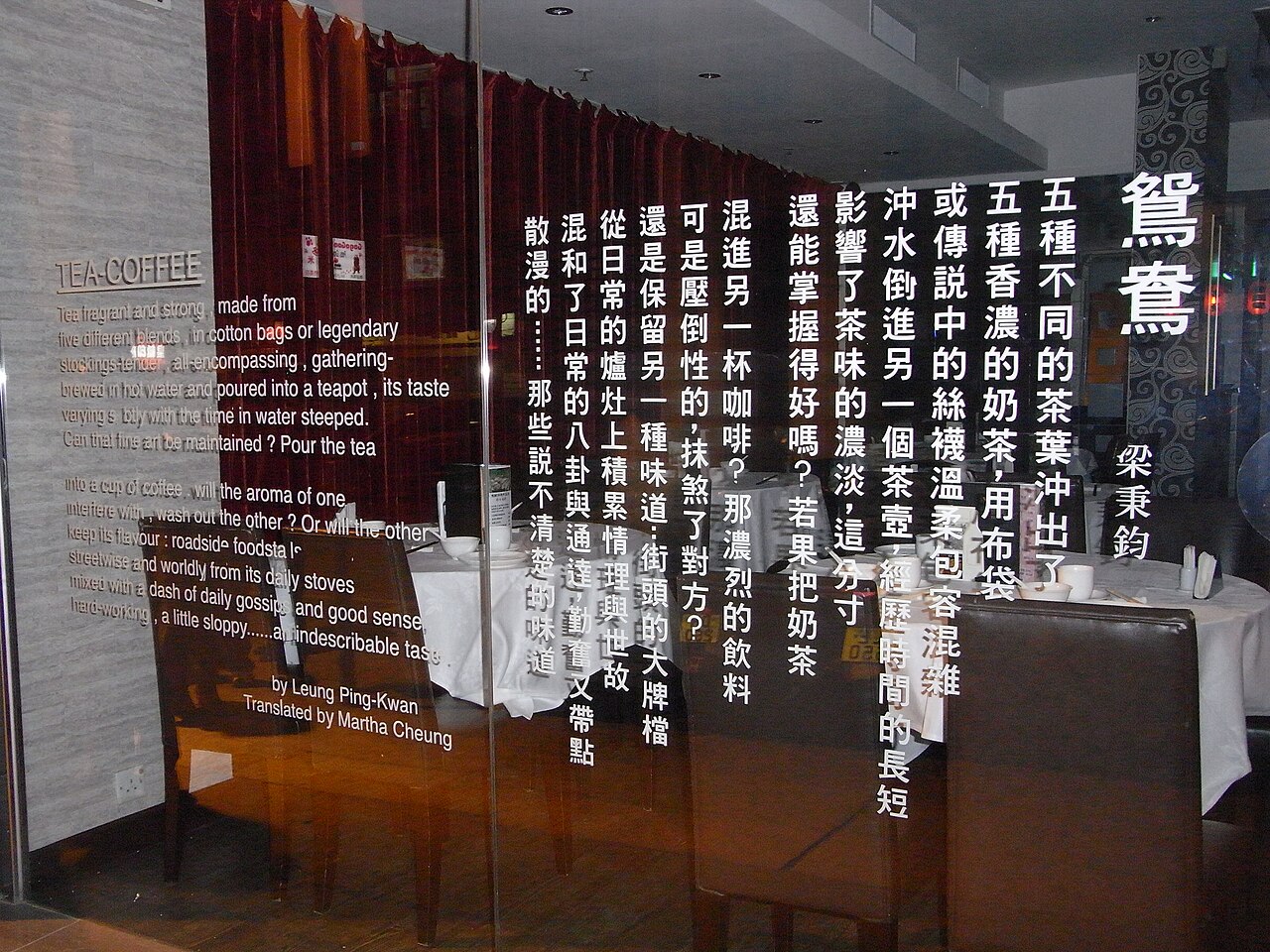
Yuenyeung mixes coffee with Hong Kong-style milk tea. It began at open-air food stalls (dai pai dong) and cafés (cha chaan teng) and is now sold almost everywhere.
The name means mandarin ducks, a pair that stands for married love. It fits a drink that pairs two unlike things.
The milk tea in it is strained through a cotton bag stained so dark it is nicknamed 'silk stocking'. Hong Kong recognised milk-tea making as intangible cultural heritage in 2017.
Coffee-tea · yuenyeung (鴛鴦)
How it's made. Hong Kong's Leisure and Cultural Services Department gives the mix as three parts coffee to seven parts Hong Kong-style milk tea, which is black tea strained through a cotton bag and made with evaporated milk and sugar.1,2
How it's served. Served hot or iced in cha chaan teng diners.
What time is taking away
What the record says
- Yuenyeung is a mix of coffee and Hong Kong-style milk tea, about three parts coffee to seven parts tea according to the Leisure and Cultural Services Department.1
- Yuenyeung means mandarin ducks, a symbol of married love, referring to the pairing of two unlike drinks.1
- Lan Fong Yuen claims its owner, Lum Muk-ho, invented yuenyeung in 1952; the claim is unverified.1,2
- Hong Kong milk tea uses evaporated milk rather than fresh milk.2
- The 'silk stocking' nickname comes from the tea-stained cotton filter bags.2
- The milk-tea making technique was recognised as intangible cultural heritage in 2017.2
- The Association of Coffee and Tea of Hong Kong has run the KamCha milk tea competition since 2009.3
Some sites claim yuenyeung itself is on the heritage list (dates 2014 or 2017); only the milk-tea technique is confirmed. The 1952 invention claim is unverified.