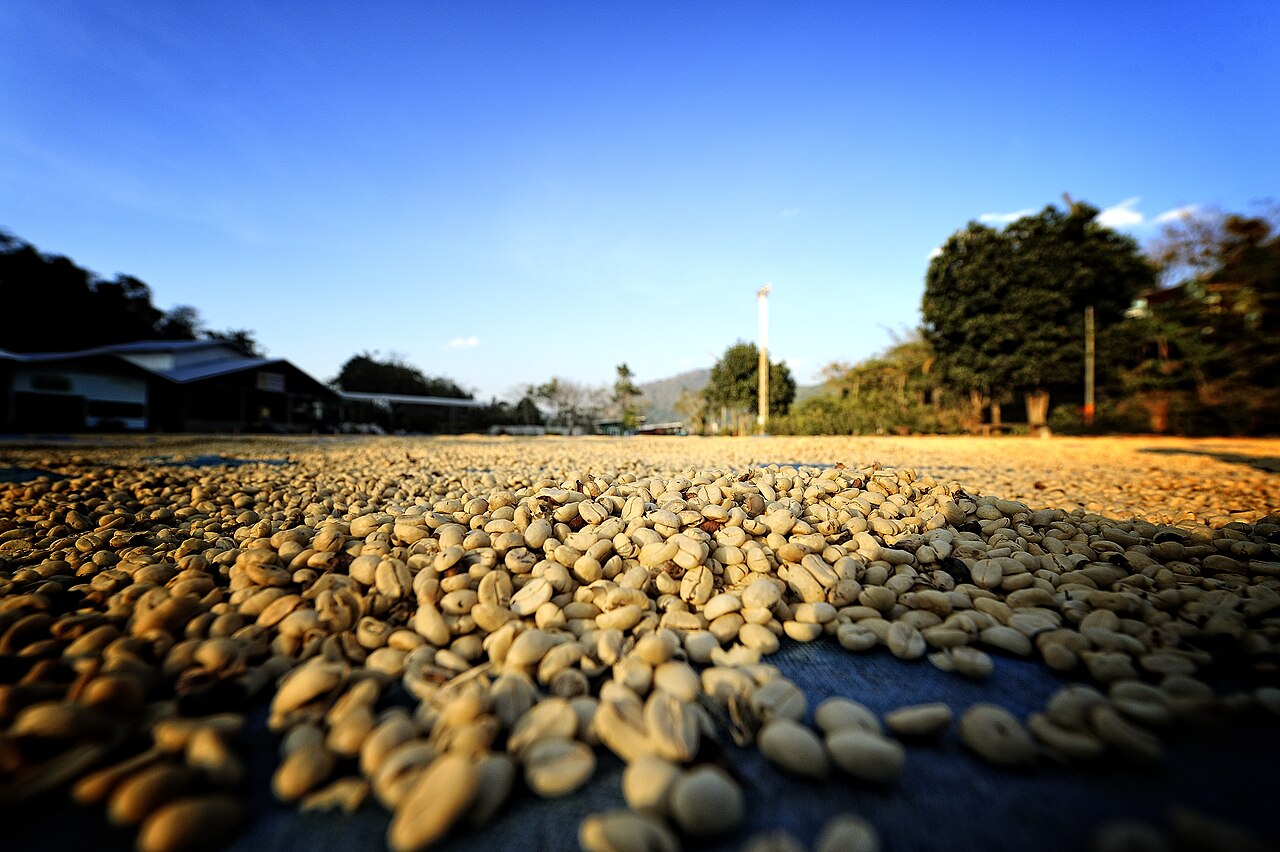
In 1969 King Bhumibol launched the Royal Project to replace opium poppies in the northern hills with other cash crops. Former poppy farmers turned to vegetables, fruit and coffee.
Coffee was slow to catch on at first. It takes three to five years to bear, and early efforts focused on crops such as peaches.
Around 1973, according to one Chiang Mai account, a rust-resistant variety from East Timor was crossed with Thai caturra. Serious coffee promotion began in the late 1980s.
Scholars note that coffee marketing often presents hill peoples in a royalist, tourist-friendly way that hides Cold War history and ecological damage.
What time is taking away
Grain-stretched Thai coffee
Traditional Thai coffee was often blended with roasted grains such as beans, wheat and corn.1
What the record says
- King Bhumibol Adulyadej launched the Royal Project in 1969 to replace opium poppies with cash crops and stop forest destruction in the northern hills.2
- Former poppy farmers became growers of vegetables, fruit and coffee; opium cultivation fell by 85 percent.2
- The Royal Project won the 1988 Ramon Magsaysay Award for International Understanding.2
- Coffee's three-to-five-year wait before harvest slowed its spread in the early Royal Project years.1
- Around 1973 a Singaporean merchant brought a rust-resistant variety from East Timor that was crossed with Thai caturra.1
- A 2025 study of Akha and Lisu growers in Chiang Rai argues that coffee marketing portrays hill people as 'culturally quaint loyal subjects' and obscures Cold War history and ecological damage.3
- Chiang Mai produces about 3,000 tonnes of coffee a year, mostly drunk in Thailand.1
The Royal Project's own site and Thai MFA PDFs could not be read (403 or undecodable). Doi Tung and Doi Chaang details came only from search snippets and are left out. The 1973 Timor-variety story comes from one city magazine.
- The First Drip: How our Coffee Cult(ure) Began · Citylife Chiang Mai, 2017 in the bibliography
- The Royal Project (1988 awardee) · Ramon Magsaysay Award Foundation in the bibliography
- From Cold War to Cold Brew: Crop Replacement Strategies, Bean Logistics, and Ethnicized Coffee Commerce in Northern Thailand · Critical Asian Studies 57(1), 2025 in the bibliography