In Eritrea, coffee is made at home every day. A ceremony takes about two hours and is held for births, baptisms, weddings and birthdays, as well as for ordinary gatherings of friends and family.
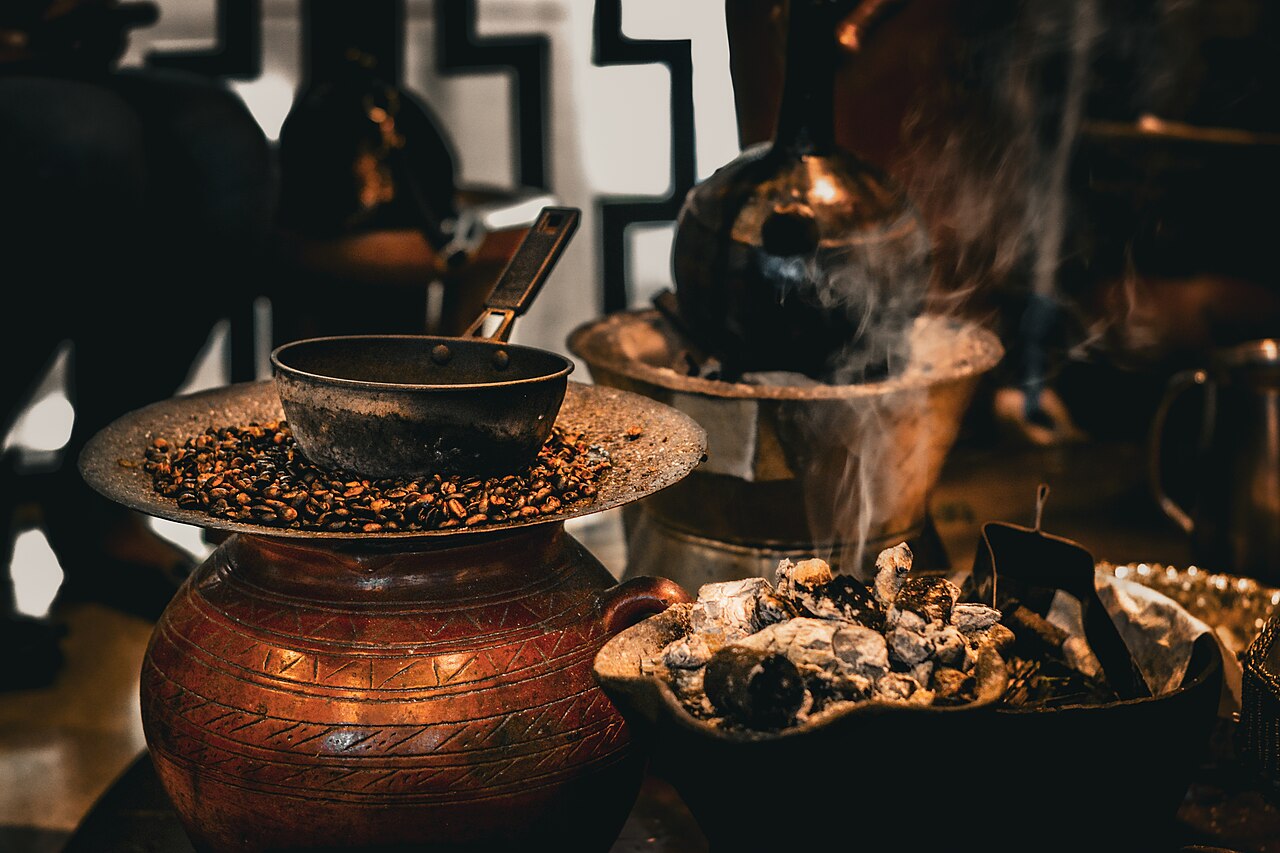
Traditionally only women make the coffee. Green beans are roasted until black, the aroma is wafted around the room on a woven grass mat, and the ground coffee is mixed with ginger and boiled in a clay jebena.
The ritual has travelled with the diaspora. Flanders' intangible heritage platform documents Eritrean coffee-making there, where it is usually kept for weekends or big celebrations.
Eritrean coffee ceremony · bun
How it's made. Green beans are roasted in a small pan until fully black and the aroma is shared by passing a woven grass mat. Ground coffee is mixed with ginger (sometimes anise or cardamom), stirred by pouring between pot and pan, and boiled in a clay jebena. A gauze plug in the pot's neck filters the coffee.1
How it's served. Three rounds from the same grounds, each slightly weaker. Cups are filled to the rim, so the first sip is taken by lifting the saucer. Roasted peanuts, popcorn and hembasha flatbread are served alongside.
What time is taking away
The coffee cabinet (bun aremadeyo)
A low cabinet holds the coffee set, with a matching cabinet for the fire. Each is unique, many women decorate theirs with LED lights and stickers, and in Eritrea a woman often receives one as a wedding gift.1
What the record says
- A full Eritrean coffee ceremony takes about two hours.1
- Traditionally only women make the coffee; at important ceremonies a hostess may invite another woman to make it, which is an honour.1
- A small family jebena yields 10 to 12 cups; larger pots are used for big gatherings.1
- Ginger is mixed into the ground coffee, sometimes with anise or cardamom.1
- In Eritrea coffee is made daily, but in Europe the ceremony is usually kept for weekends or big celebrations.1
- The practice is passed down orally across generations.1
One source only (Flemish intangible heritage platform, describing the diaspora practice). Asmara's Italian espresso and macchiato culture appeared only in travel blogs and Wikipedia mirrors, so it was left out. Round names were not given by the opened source.
- Eritrese koffie maken in Vlaanderen · immaterieelerfgoed.be (Flemish intangible heritage platform) in the bibliography