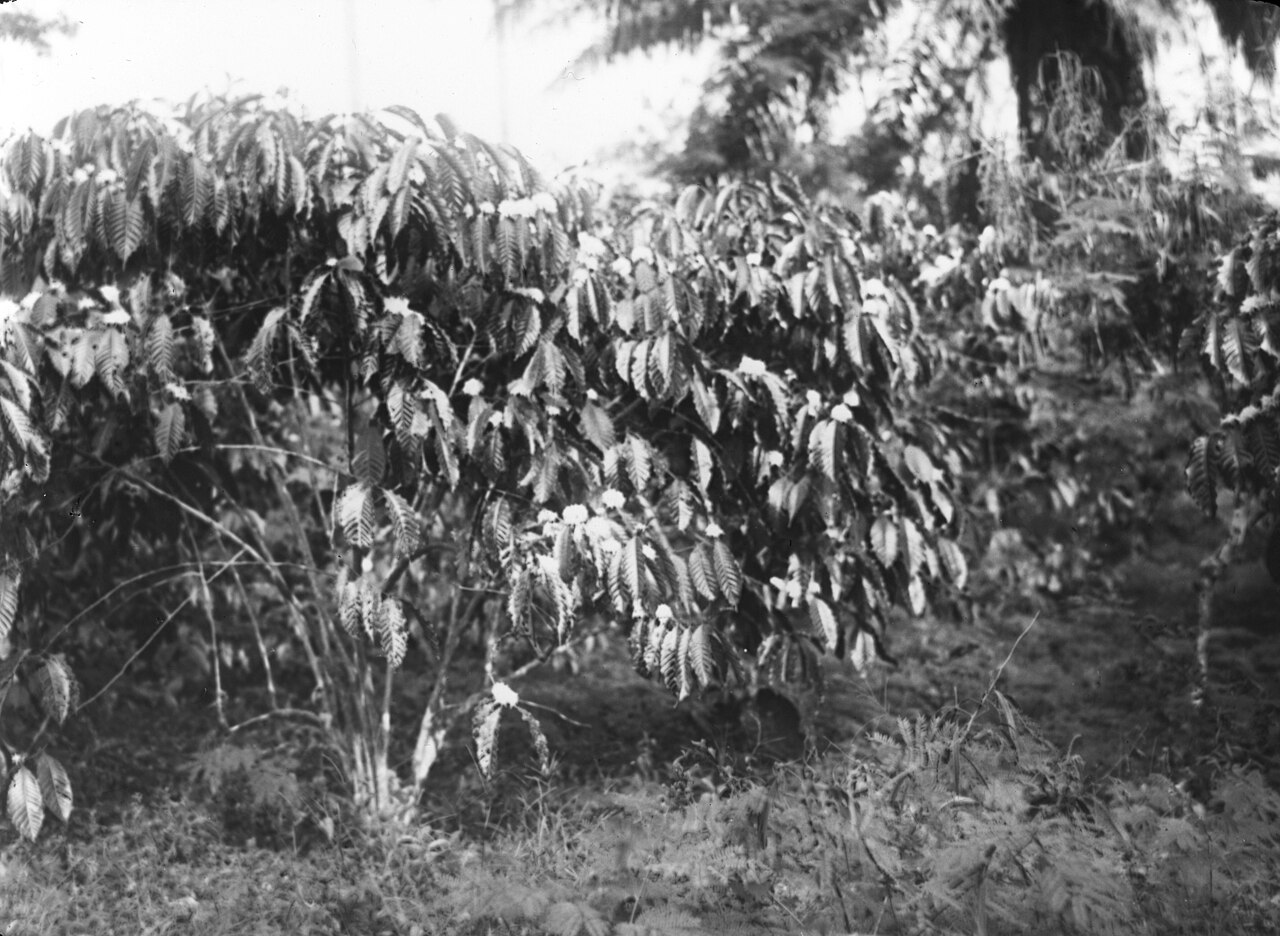
The Kafa forests of southwest Ethiopia are described as the birthplace of Coffea arabica, and many wild coffee varieties still grow there. The area joined UNESCO's network of biosphere reserves in June 2010 and covers about 760,000 hectares.
Those wild populations are under pressure. When Kew scientists factored in climate change, wild arabica moved up two categories to endangered, and only about 4% of the potential forest where it grows in Ethiopia and South Sudan lies inside protected areas.
At home, coffee is a ceremony called buna in Amharic. Green beans are roasted in front of guests, ground by hand, boiled in a clay jebena and served over three rounds, the last called baraka, or blessing.
According to legend, a goat herder named Kaldi noticed his goats grew lively after eating coffee cherries. The story is a legend, and there is no record of who first discovered coffee.
Ethiopian coffee ceremony · buna
How it's made. Green beans are roasted in a flat pan in front of guests, and the hot beans are passed around so people can smell them. They are ground by hand with a mortar and pestle and boiled in a long-necked clay pot called a jebena. Incense is lit at the start.1,2
How it's served. Poured from a height into small handleless cups over three rounds: abol (strongest), tona and baraka ('blessing'). Popcorn, roasted barley or peanuts are often served. Women traditionally make the coffee, and a full ceremony can take a couple of hours.
What time is taking away
Buna qalaa (coffee cooked in butter)
Among the Guji and in the Borana Gadaa system of Oromia, sun-dried whole coffee cherries are nicked at the tip, heated in butter in a clay pot, coated with boiled milk and chewed rather than brewed. The name is said to mean 'coffee slaughtering'. It is served at childbirth, naming ceremonies, weddings, reconciliations and the close of mourning.5,9
Kuti (coffee-leaf tea) in Harar
In Harar, people have drunk an infusion of coffee leaves for hundreds of years. Beans were kept for trade and for ceremony, so kuti became the everyday drink of the Harari people, and some households kept rooms for storing leaves. The leaves are boiled for at least 30 minutes, sometimes with a pinch of salt, and sugar is added when served.6
What the record says
- The Kafa forests joined UNESCO's network of biosphere reserves in June 2010, and the reserve was inaugurated in Bonga on 22 March 2011.3
- The Kafa reserve covers about 760,000 hectares and holds one of Ethiopia's last montane forest areas, mostly cloud forest.3
- Once climate change was factored in, wild arabica moved up two threat categories to endangered.4
- Only about 4% of the potential forest area where wild arabica occurs in Ethiopia and South Sudan lies within protected areas.4
- The ceremony's three rounds are abol, tona and baraka; baraka means 'blessing'.1,2
- Coffee is traditionally served two or three times a day, and hosts call out 'Buna Derswal!' when it is ready.2
- In buna qalaa the beans are chewed and eaten, not brewed, and the dish is served in a cup called a mudunu.5
- Harar was a major trade centre linking Ethiopia, the Horn of Africa and the Arabian Peninsula from the late 16th to the 19th centuries.6
- The Kaldi goat-herder story is a legend; there is no official record of who first discovered coffee.7,8
Ceremony details come from a 2012 KQED piece and a 2026 Africa.com article, not a scholarly source. Buna qalaa sources (Barista Magazine, Visit Oromia) differ slightly: one names the Guji and Borana, the other just Oromia. Kuti rests on one SBS article that cites Burhardt and Koehler. Kaldi: the 1671 Nairon first-print claim was seen only in search snippets, so it was left out. A reported 2015 UNESCO inscription of the Ethiopian ceremony appeared only on weak sites and was not used; Barista Magazine (2025) describes a UNESCO bid as still in progress. Altitude and harvest months were not found in an opened source.
- How Ethiopia turns coffee into shared hospitality · Africa.com (Getaway), 2026 in the bibliography
- Traditional Ethiopian coffee ceremony brewed up by Chef Marcus Samuelsson and Cafe Colucci · KQED Bay Area Bites, 2012 in the bibliography
- UNESCO biosphere reserve in Ethiopia · International Climate Initiative (IKI), German government, 2011 in the bibliography
- Coffee in trouble: 60% of wild coffee species threatened with extinction · Mongabay, 2019 in the bibliography
- Preserving an age-old coffee tradition: a look at Ethiopia's buna qalaa · Barista Magazine, 2025 in the bibliography
- Are we ready for tea made from coffee leaves? · SBS Food, 2020 in the bibliography
- History of coffee · National Coffee Association USA (About Coffee) in the bibliography
- Who first figured out how to make coffee? · The Straight Dope in the bibliography
- Buna Qalaa (photo: Moti Pictures) · Visit Oromia via Google Arts & Culture in the bibliography