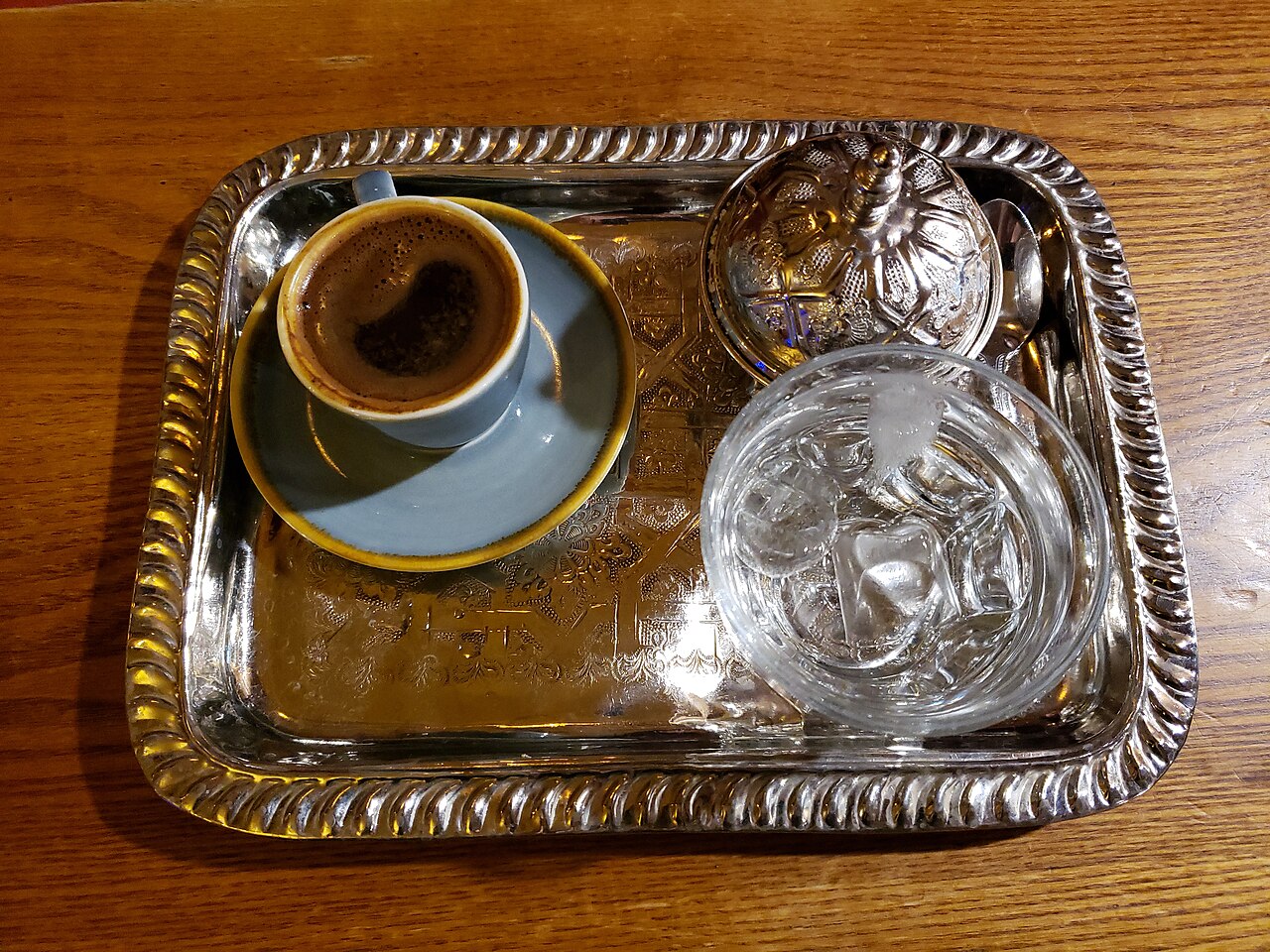
Lebanese coffee is made in a long-handled pot called a rakweh. Cold water, finely ground coffee and often a pinch of cardamom are heated until they rise, three times over.
Guests are almost always offered coffee on arrival, however short the visit. Afterwards, some turn the cup upside down on its saucer so a reader can interpret the shapes the grounds leave.
After a heavy meal, many drink 'white coffee'. It is boiling water scented with orange blossom water and contains no coffee at all.
Lebanese coffee · ahweh
How it's made. About a teaspoon of ground coffee per cup goes into cold water in a rakweh, with optional sugar and cardamom. It is heated until it rises, taken off the heat and brought back to the boil, three times.1
How it's served. Poured in front of the guest into espresso-sized cups, with a glass of cold water. The grounds are left to settle before drinking.
What time is taking away
Coffee-cup reading
The drinker leaves a thin layer of coffee, covers the cup with a saucer, turns it upside down and waits about two minutes. A reader, often the host, interprets the shapes left by the grounds.1
White coffee (ahweh bayda)
Boiling water scented with orange blossom water, with optional sugar, drunk after heavy meals. Despite the name it has no coffee or caffeine.1
What the record says
- Lebanese coffee is boiled up three times in a rakweh to get a strong flavour without over-boiling.1
- The coffee is not filtered, so the grounds need a few minutes to settle.1
- Guests are almost always offered coffee on arrival, however short the visit.1
- Sugar used to be added during brewing; now coffee is often made without and sugar offered separately.1
- Lebanese 'white coffee' is hot water with orange blossom water and contains no coffee.1
One source, Beirut's Food Heritage Foundation, which is credible on Lebanese food practice. Wider Levant (Syria, Jordan, Palestine) not separately sourced. Funeral coffee customs were searched for but not found in an opened source.
- Lebanese coffee · Food Heritage Foundation (Beirut) in the bibliography