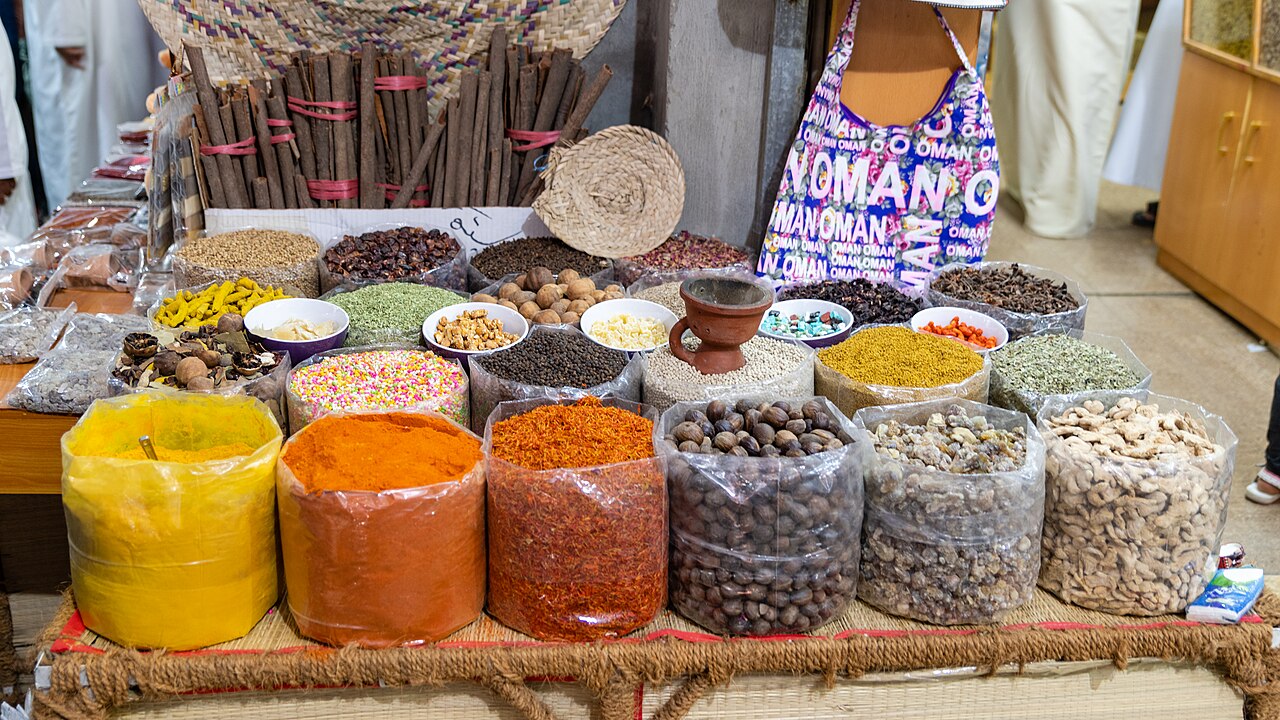
In Oman, coffee and dates open a visit. Green beans are roasted dark and ground by hand in a stone mortar with spices, often saffron, rose water and cardamom.
A bowl of water sits beside the dates so guests can rinse their fingers. To get more coffee, a guest hands the cup back; to decline, they shake it first.
At weddings, Omani halwa is served with the coffee, and by tradition guests eat the halwa before they drink.
Omani coffee · qahwa
How it's made. Green beans are roasted until dark and ground by hand in a stone mortar with spices such as saffron, rose water and cardamom, sometimes cloves and cinnamon. The grounds are boiled in water.1
How it's served. In small cups with dates, which stay out for the whole visit. Guests hand the cup back for more and shake it to decline. At weddings it comes with Omani halwa, eaten first.
What the record says
- Omani qahwa is ground by hand in a stone mortar together with spices.1
- Saffron, rose water and cardamom are the main flavourings; some households add cloves and cinnamon.1
- Many families pass down their own recipe, though some now use instant coffee.1
- Coffee and dates stay out until the visit ends, while other dishes come and go.1
- At weddings, guests traditionally eat Omani halwa before drinking the coffee.1
- Oman is one of the states in UNESCO's listing of Arabic coffee as 'a symbol of generosity'.2
Main source is one Oman Observer article (2019). The Smithsonian Folklife piece on Omani coffee pots returned 403. Frankincense-flavoured coffee appeared only in blogs and was left out.
- Omani qahwa: the essence of Omani hospitality · Oman Observer, 2019 in the bibliography
- Arabic coffee, a symbol of generosity · UNESCO Intangible Cultural Heritage, 2015 (extended 2024) in the bibliography