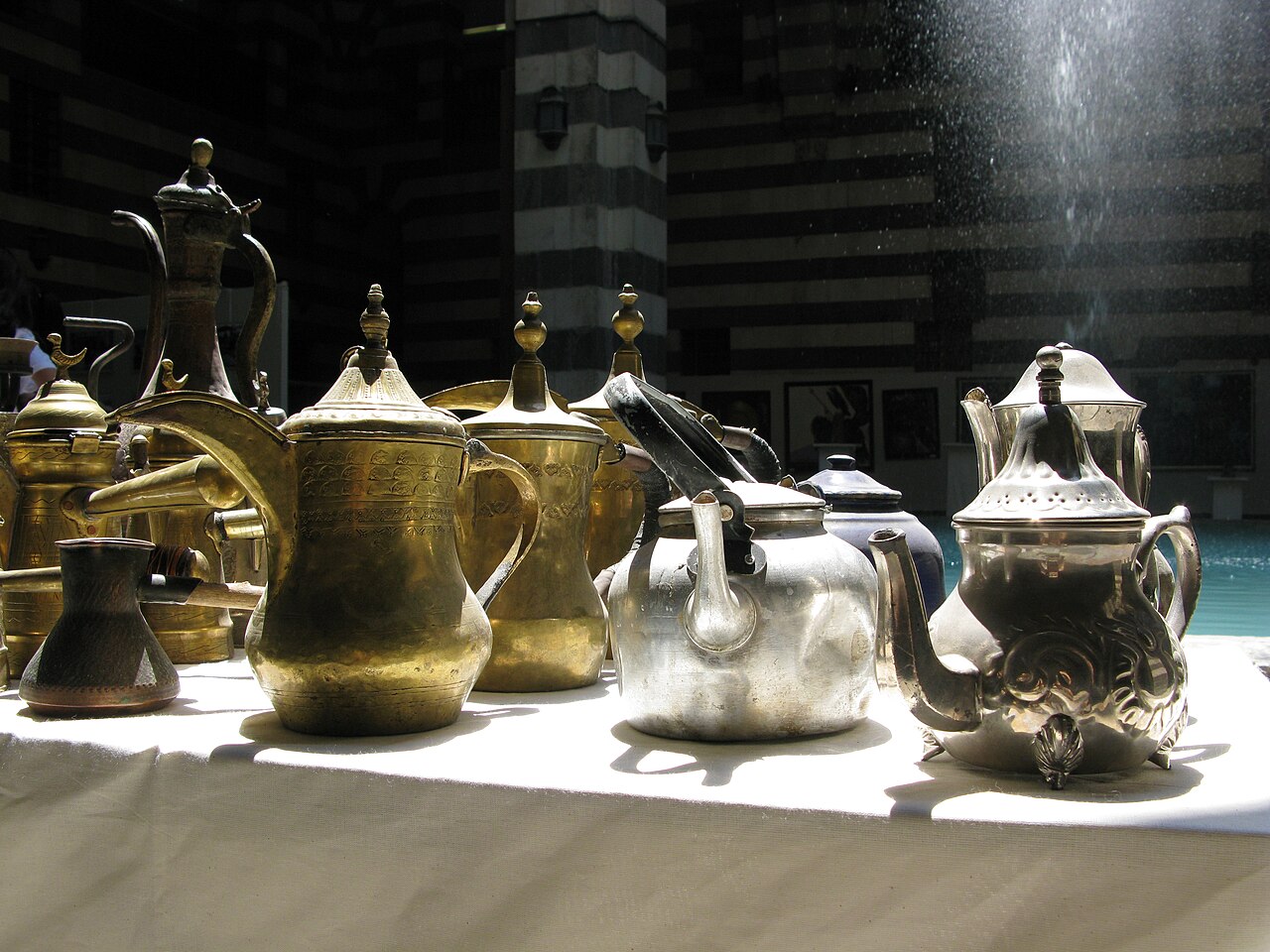
Arabic coffee is roasted, ground and boiled with cardamom, then poured from a dallah into small cups filled only about a quarter full. The oldest or most important guest is served first.
UNESCO added Arabic coffee to its intangible heritage list in 2015 after a joint bid by the UAE, Saudi Arabia, Oman and Qatar. Jordan joined an extended listing in 2024.
Coffee was not always welcome in the region. In 1511, Mecca's market inspector Khair Beg banned coffee gatherings, and the Mamluk sultan ordered its sale stopped.
Arabic coffee · gahwa
How it's made. Beans are sorted, washed, dried and roasted until red or brown, then ground and boiled with cardamom in a large dallah. Three pots are used: one for boiling, one for filtering, one for serving.1,2
How it's served. The server holds the dallah in the left hand and the cup (finjal) in the right. The oldest or most important guest is served first. Cups are filled about a quarter full; guests usually drink at least one and no more than three, and shake the cup to show they are finished.
What time is taking away
Mecca's coffee ban of 1511
After a 1509 debate in which Mecca's chief Shafi'i judge permitted coffee, market inspector Khair Beg banned coffeehouse gatherings in June 1511, saying they met 'in a manner similar to taverns'. Violators were lashed and paraded through the market.4
What the record says
- UNESCO inscribed Arabic coffee as 'a symbol of generosity' in 2015, at a meeting in Windhoek, Namibia, after a joint nomination by the UAE, Saudi Arabia, Oman and Qatar.3
- Jordan joined the UNESCO listing in an extended inscription in 2024.2
- Arabic coffee is served at weddings, tribal gatherings and reconciliation councils (majalis).2
- The coffee is poured with the right hand, and drinkers shake the cup to show they have had enough.2
- Young people learn to choose beans by going to market with their elders.3
- The traditional dallah set has three pots: dallat al-khumrah for boiling, dallat al-talgeemah for filtering and dallat al-mazalah for serving.1
- In June 1511 Mecca's market inspector Khair Beg enforced a sweeping ban on coffee gatherings.4
- Coffee reached Mecca around 1500, and pilgrims helped spread news of coffee houses.4,5
UNESCO page now shows the 2024 extended inscription; the 2015 date and original four states come from Egyptian Streets news coverage. Gahwa preparation is from Abu Dhabi's Department of Culture and Tourism, so it reflects Emirati practice. Saffron and dates were not confirmed by the opened sources for this entry.
- Gahwa - Arabic coffee · Abu Dhabi Department of Culture and Tourism (abudhabiculture.ae) in the bibliography
- Arabic coffee, a symbol of generosity · UNESCO Intangible Cultural Heritage, 2015 (extended 2024) in the bibliography
- UNESCO adds Arabic coffee to intangible cultural heritage list · Egyptian Streets, 2015 in the bibliography
- Brewing controversy: how coffee sparked fierce debate in the 16th century · Medievalists.net (summarising Reda Asaad Sharif, Darah journal), 2025 in the bibliography
- History of coffee · National Coffee Association USA (About Coffee) in the bibliography