Vienna's coffee-house culture has been on Austria's national inventory of intangible cultural heritage since 2011. The listing describes a place where time and space are consumed, but only the coffee goes on the bill.
The story goes that after the Ottoman siege of 1683 failed, the Viennese found sacks of coffee left behind. A man named Kulczycki is said to have opened the first coffee house with them. That is a legend. Records point instead to an Armenian, Johannes Diodato, who opened the first coffee house in 1685.
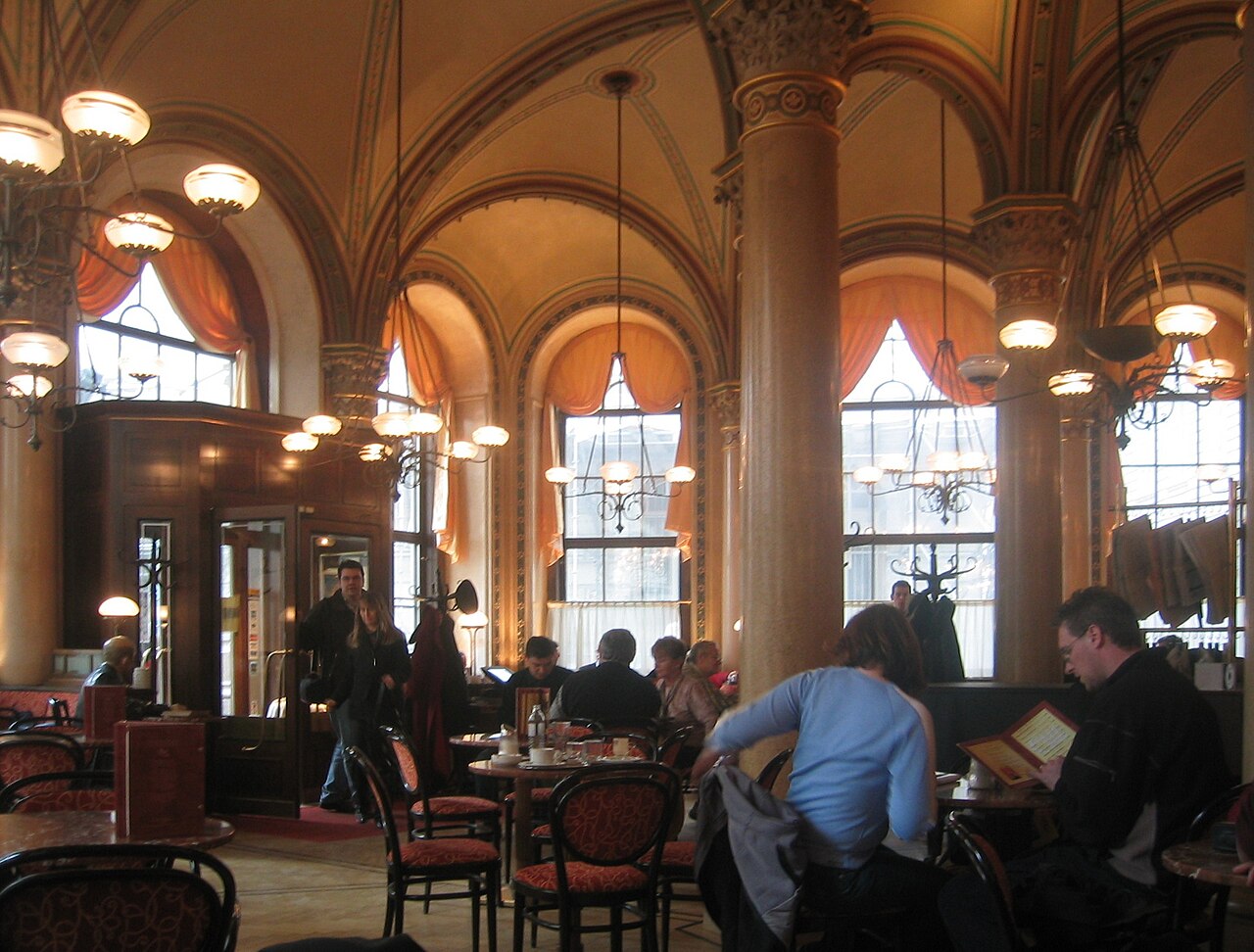
Coffee comes on a tray with a glass of water. Guests read newspapers, play cards or chess, and stay for hours. At its peak in the 1910s the city had around 600 coffee houses.
Viennese coffee-house visit · Wiener Kaffeehauskultur
How it's made. Coffee such as a Melange (half coffee, half milk) or an Einspänner (espresso with hot water and whipped cream) is brought on a silver tray with a glass of water and a spoon.1,2
How it's served. Drunk at marble tables on Thonet chairs, often alone with the newspapers, and lingering for hours is normal.
What time is taking away
What the record says
- Viennese coffee-house culture was added to Austria's national inventory of intangible cultural heritage in 2011.3,4
- The inventory describes the coffee house as a place where time and space are consumed but only the coffee appears on the bill.3
- According to legend, soldiers found coffee sacks after the failed siege of 1683 and Jerzy Franciszek Kulczycki opened the first coffee house; research instead credits Armenian businessman Johannes Diodato (Theodat) with the first, in 1685.1,2
- The Kramer coffee house on the Graben was the first to offer newspapers, in 1720.3
- Napoleon's Continental System (1803–1813) made coffee very expensive and coffee houses nearly collapsed; in 1808 they were allowed to serve wine and warm food.3
- Women were at first excluded from Vienna's coffee houses and were admitted in 1856.3
- At its peak in the 1910s, Vienna had around 600 coffee houses.1
- Café Landtmann was Sigmund Freud's preferred café, and Karl Kraus's journal Die Fackel is said to have been largely written in cafés.2
- Tourism now puts pressure on the tradition; some regulars have stopped going because crowds stop them reading or meeting friends as before.4
Some sources say UNESCO itself 'declared' the culture heritage in 2011; the Austrian UNESCO commission page shows it is on Austria's national inventory, not UNESCO's international Representative List, so we say 'national inventory'. The Kulczycki/Blue Bottle story is kept as legend. Austria.info calls Diodato a spy born in Istanbul; Wikipedia calls him an Armenian businessman; both agree on 1685. The claim that Stalin, Hitler, Trotsky and Tito all frequented cafés in 1913 was left out (uncited).
- Viennese Coffeehouse Culture · Austrian National Tourist Office (austria.info) in the bibliography
- Viennese coffee house · Wikipedia in the bibliography
- Wiener Kaffeehauskultur · Österreichische UNESCO-Kommission (Austrian Commission for UNESCO), national inventory of intangible cultural heritage, 2011 in the bibliography
- Viennese coffeehouse culture (case study) · ICH NGO Forum in the bibliography