Coffee reached Bosnia under the Ottomans, by way of Istanbul. In Sarajevo it moved from wealthy homes to the coffee houses of the old bazaar and then into every home.
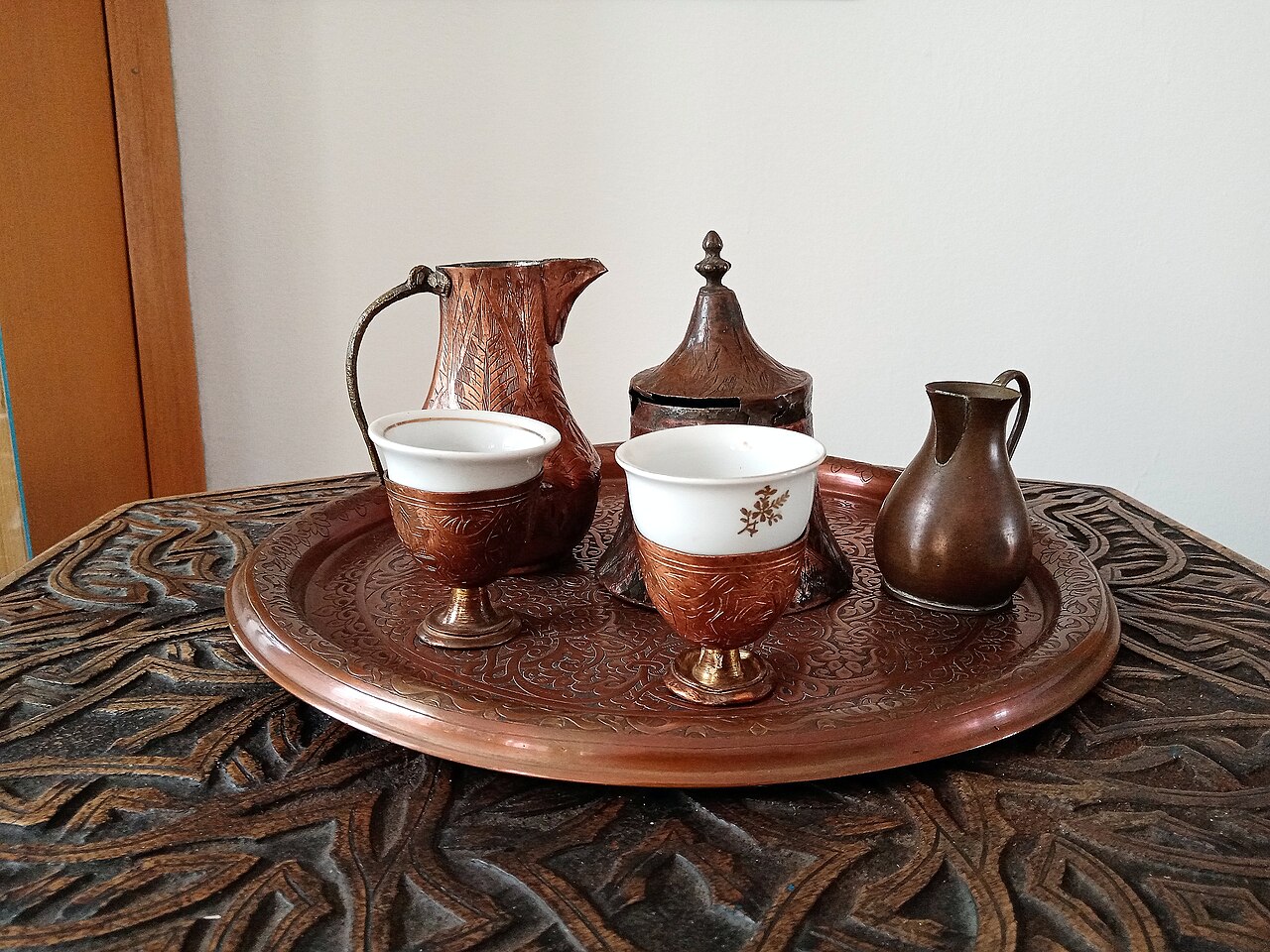
It is served on a copper tray with a long-handled pot called a džezva, small handleless cups called fildžani, sugar and Turkish delight. In traditional cafés a glass of water comes too.
Each coffee has a name for its moment. Razgalica wakes you in the morning. Razgovoruša gets conversation going. Dočekuša welcomes guests. Sikteruša is a quiet hint that it is time for guests to go.
Bosnian coffee · bosanska kahva
How it's made. Ground coffee goes into a džezva, boiled water is added, and it is stirred and heated until it rises without spilling over, then rested briefly. Some set aside a cup of the hot water and pour it over the foam at the end.1,2
How it's served. On a copper tray (tabla) with fildžani, a sugar holder (šećerluk) and Turkish delight; sip the water first to clean the palate.
What time is taking away
Šiš roasting
Coffee was once roasted in a metal cylinder or pan called a šiš; Sarajevo's Tahmis guild roasted and sold coffee near the Emperor's Mosque. The practice is nearly extinct.1,2
Sugar-cube dipping
Drinkers dip a piece of sugar into the coffee and eat it while sipping; it is now mostly done at home, though a few cafés keep it alive.2
Sikteruša
A coffee served as a subtle sign that guests should leave, one of several named coffees for different times and occasions.1
What the record says
- The word kahva comes from Turkish kahve, from Arabic qahwah; coffee reached the region via Istanbul under the Ottomans.1
- A full coffee set, the kahveni takum, includes a copper tray (tabla), a džezva, a šećerluk for sugar and Turkish delight, and handleless fildžani.1
- Men's fildžani were historically tiny, 'as small as an eye', while women's cups were larger and often held weaker coffee or coffee with milk.1
- Named coffees include razgalica (morning), razgovoruša (for conversation), šutkuša (quiet evening), dočekuša (for guests) and sikteruša (a sign guests should leave).1
- In Bosnian preparation, some of the boiled water is set aside and added after the coffee, unlike the Turkish method of heating coffee and water together.2,3
- In Sarajevo, asking for 'Turkish coffee' may get you corrected: it is Bosanska kafa, Bosnian coffee.4
- Sarajevo's Tahmis guild roasted coffee in a šiš near the Emperor's Mosque; industrialisation left only a couple of roasting shops.1
- A Sarajevo outlet claims the city's first coffee house opened in 1534 in Bentbaša.5
The 1534 Sarajevo date is a local claim and conflicts with Istanbul's first coffee houses being dated 1554–1555; treat with caution. The Bosnian-coffee encyclopedia link resolves to the general Turkish coffee article. No UNESCO listing for Bosnian coffee was found.
- Bosnian coffee · Sarajevo Navigator (formerly sarajevo.travel) in the bibliography
- More than a drink, real kafa is a ritual · Via Dinarica / Terra Dinarica, 2019 in the bibliography
- Bosnian coffee (Turkish coffee article) · Wikipedia in the bibliography
- Don't Call It 'Turkish' Coffee, Unless, Of Course, It Is · NPR (The Salt), via KUNC, 2013 in the bibliography
- A brief History of the Sarajevo cafés: 500 Years long Tradition · Sarajevo Times, 2020 in the bibliography