By the 1400s Sufi communities in Yemen drank coffee to stay awake through night-time prayers. Coffee went from Yemen to Mecca around 1500, then on to Egypt, Syria, Iran and Turkey.
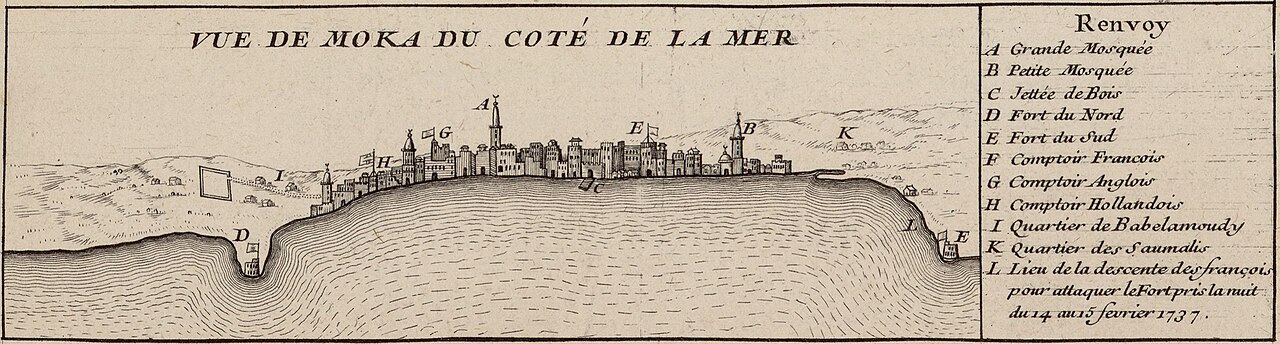
Yemen's traders guarded their monopoly. Fertile seeds and live plants were not allowed out. The Dutch broke it: they took plants from Mocha to Amsterdam in 1616 and later grew coffee on Java.
From there coffee crossed the Atlantic. A French officer carried a seedling to Martinique. A Portuguese officer obtained seeds from French Guiana, hidden, the story goes, in a bouquet from the governor's wife, and began Brazil's coffee industry. By 1852 Brazil was the world's largest producer.
What the record says
- In the 15th century, coffee drinking was well established among Sufi communities in Yemen, who used it to stay alert during night devotions.1,2
- The Ethiopian goat-herder Kaldi is a legend: the story does not appear before 1671 and the name seems to be a later invention.1,3
- Coffee reached Mecca around 1500 (AH 905).2
- By the 16th century, coffee had spread from Yemen to Iran, Egypt, Syria and Turkey; pilgrims to Mecca carried news of coffee houses home.3
- Coffee traders kept fertile seeds and living plants from leaving the Arabian Peninsula; in 1616 Pieter van den Broecke took coffee plants from Mocha to Amsterdam.4
- The Dutch obtained seedlings in the late 1600s; attempts in India failed but trees thrived on Java.3
- French naval officer Gabriel de Clieu carried a coffee seedling to Martinique; that tree is described as the ancestor of many coffee trees in the Americas.3
- In 1727 Francisco de Melo Palheta began coffee cultivation in Brazil using seeds from French Guiana; the story says they were hidden in a bouquet from the governor's wife.1,3
- By 1788 Saint-Domingue supplied half the world's coffee, and by 1852 Brazil was the largest producer.1
The de Clieu date is 1720 in one source and 1723 in another, so it is omitted. The bouquet story about Palheta is kept as a story. Al-Jaziri's claim that the mufti of Aden first adopted coffee around 1454 was left out to keep to well-supported points.
- History of coffee · Wikipedia in the bibliography
- Brewing Controversy: How Coffee Sparked Fierce Debate in the 16th Century (on Reda Asaad Sharif's study in Darah, Brill) · Medievalists.net, 2025 in the bibliography
- History of Coffee · National Coffee Association USA (aboutcoffee.org) in the bibliography
- How coffee went from the hands of the Dutch to the world · The Jakarta Post, 2018 in the bibliography